Laser welding machines of the latest generation

Perfect weld seams without compromise: Our laser welding machines are the ideal solution for companies seeking precise and efficient welding technology. With state-of-the-art laser technology, our machines provide top-quality weld joints with minimal energy consumption.

Laser welding machines: Weld materials cleanly

Laser welding machines offer cutting-edge technology for precise, repeatable weld joints in various industries. The machines use a focused laser beam to quickly and accurately weld metals and non-ferrous metals such as bronze alloys, copper, steels and stainless steels, aluminum, and even plastics.

They enable combustion-free weld seams with minimal thermal interference and virtually reduce process failures due to weld seam fractures to zero. The integrated CNC control provides 100% reproducible welding results combined with the shortest downtime in your process chain, maximum efficiency, and the lowest operating costs. This makes them ideal for companies that need to enhance their manufacturing efficiency while delivering high-quality, flaw-free products.
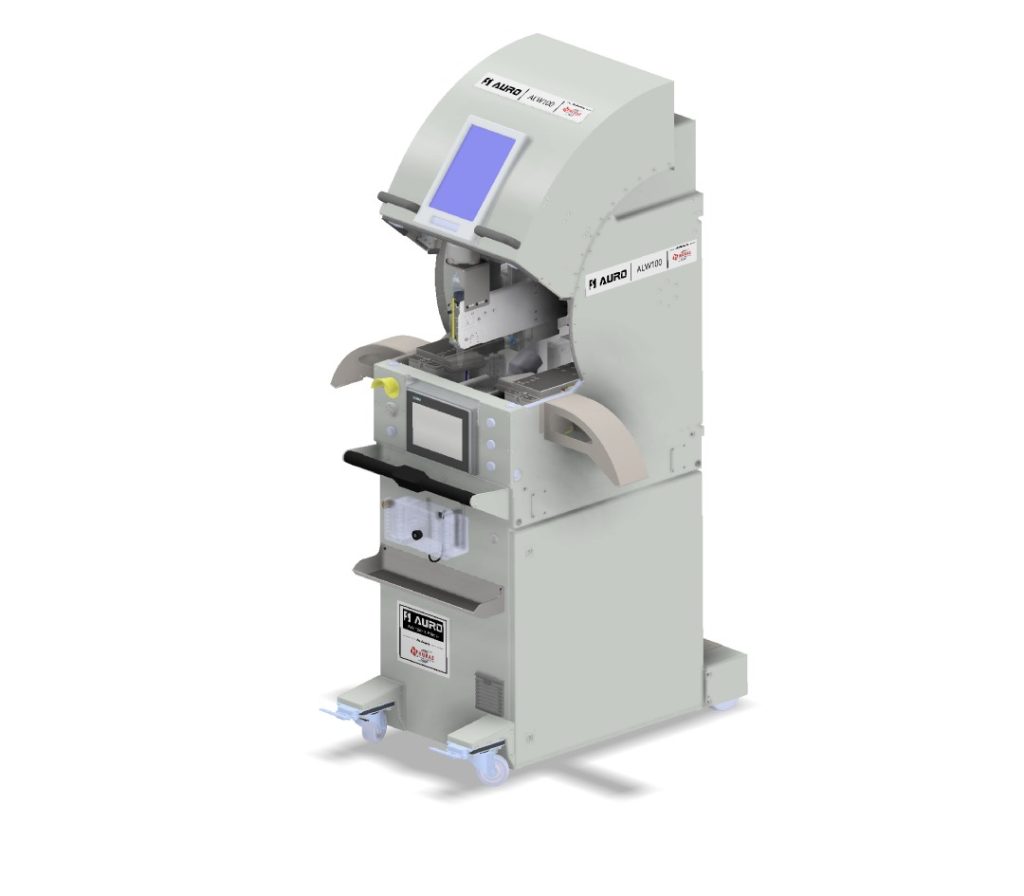
Design by AURO, manufactured by Huras Stanzautomation GmbH

The main advantages at a glance

  • No consumption of electrodes, fuel and shielding gases
  • No emissions of metal fumes and welding gases thus highest occupational safety
  • Classic cutting tool for separating material strips is eliminated, thus maintenance-free
  • Scalpel quality, the laser diameter of 0.5mm allows minimal thermal load on the material to be welded
  • None to minimal structural changes, outgassing and optical damage to the material
  • Minimal risk of weld site failure in further processing
  • No operator errors possible due to fully automated process

Product features & technical details

  • NC controlled, therefore almost all cutting geometries possible
  • Parameter analysis via a profilometer before and after the welding process
  • Trial welds possible without mains connection (integrated battery available)
  • Easy to maneuver thanks to integrated floor handling.
  • Retractable, space-saving touch HMI
  • All machine functions are easily accessible and intuitively controllable via the touch panel.
  • Various operating modes and parameters of the welding process can be conveniently and precisely set via the touch panel.
  • Drawer for accessory storage
  • Workpiece lengths/material lengths from 50 mm.
  • Multiple welding processes possible
  • Cycle times start at approx. 6 seconds
  • The machine is fully automated but can also be used manually
  • Additional accessories can be linked if needed

Product data

MAXIMUM BANDWIDTH
100 mm
BAND THICKNESS
0.2-1.2 mm
LASER CLASS
1
LASER POWER
1500 Watt (fiber laser)
Laser welding machine ALW100

Determine the profitability
– ROI Calculator

Advantages of our laser welding machines

Easy operation

Thanks to thoughtful design and optimized solutions, the operator can easily use the laser welding machine after a short training session. The intuitive user interface makes getting started easy and efficient.

Low Radiation for Light Protection

The machine generates only low indirect radiation. The operator only needs protective goggles to shield against the intense light of the laser.

High Welding Speed

Laser welding is up to 10 times faster than conventional methods, significantly increasing productivity. This leads to faster processing times and higher efficiency in production.

Quality Welds Without Deformation

The concentrated laser beam keeps the heat-affected area small, causing only minimal structural changes to the material. This ensures precise welds without material damage.

Reproducible Welds

Laser welding machines offer 100% reproducibility of welds. The joints are not only aesthetically pleasing but also extremely strong and stable.

Welding Thin Materials

The machine can weld very thin materials, such as 0.20 mm stainless steel. This opens up new possibilities in fine machining and precise manufacturing.

Integrated Laser Cleaning Function

In addition to welding, the machine can also be used for laser cleaning. This expands the range of applications and ensures clean, ready-to-process surfaces.

Integrated Cutting Function

The machine offers a cutting option that enables precise cuts without mechanical rework. This saves time and improves efficiency in production.

Good Sealing

The laser allows for unique shaping without consumables, ensuring better sealing around the workpiece. This significantly improves sealing performance.

High Compatibility

The custom clamping fixture design allows adaptation to various product specifications. Reconfiguration is quick and takes less than 5 minutes.

NC-Controlled Precision for Wide Cut Profiles

Thanks to precise digital control, almost any desired cut profiles can be executed. This allows for complex geometries and high repeat accuracy in every application.

Compact Design with Small Footprint

The laser welding machine impresses with its space-saving design and requires only a small footprint. This allows the machine to be easily integrated into even confined production environments without blocking valuable space.

Applications of Our Laser Welding Machines

  • Automobile Industry: Companies in automobile manufacturing use laser welding to connect components such as body parts, transmissions, or exhaust systems precisely and quickly.
  • Aerospace: In aviation, laser welding is used to connect lightweight yet high-strength materials such as titanium and aluminum for aircraft parts, like welding turbine blades or fuselages.
  • Electronics Industry: In electronics production, laser welding is used for the precise connection of small components and housings, such as for batteries or circuit boards and other electronic devices.
  • Metalworking: Laser welding is used in general metalworking to create precise connections between metal parts, such as in the manufacture of metal housings, frames, or machine parts.

Contact

If you would like advice, a quote, or more information about our product, please inquire directly through our form.

FAQ: Answers to the Most Important Questions

How Does a Laser Welding Machine Work?

A laser welding machine uses the energy of a highly focused laser beam to join materials. The process is based on the intense heat generated by the laser to melt the surfaces of the workpieces and weld them together. The process is extremely precise and efficient, suitable for various materials and applications. The following process is typical:

  1. Laser beam generation: The laser is generated in a source and focused using lenses to direct a high-intensity beam onto the workpiece.
  2. Melting the material: The laser heats the material at the contact point, creating a molten pool that melts the surfaces of the workpieces.
  3. Joining: After the laser is removed, the molten pool solidifies, creating a strong bond between the workpieces.
  4. Welding processes: There are different types of welding such as deep welding (deep seams), heat conduction welding (flat seams), and spot welding (spot connections).
  5. Fusion: The materials are fused through the welding process. Thanks to high control over the laser beam, companies can achieve clean, high-quality welds with minimal distortion and material loss.

With a laser welding machine, you can weld various materials:

  • Metals: Steel and stainless steel, aluminum, titanium, copper, nickel alloys
  • Precious metals: Gold and silver, platinum
  • Plastics, such as thermoplastics and other plastics
  • Coated materials: Materials with protective coatings or surface treatments, e.g., galvanized steel.
  • Mixed materials, e.g., steel with aluminum, when specific welding parameters are set.

FAQ: Answers to the most important questions

How does a laser welding machine work?

A laser welding machine uses the energy of a highly focused laser beam to join materials. The process is based on the intense heat generated by the laser to melt the surfaces of the workpieces and weld them together. The process is extremely precise and efficient, suitable for various materials and applications. The following process is typical:

  1. Laser beam generation: The laser is generated in a source and focused using lenses to direct a high-intensity beam onto the workpiece.
  2. Melting the material: The laser heats the material at the contact point, creating a molten pool that melts the surfaces of the workpieces.
  3. Joining: After the laser is removed, the molten pool solidifies, creating a strong bond between the workpieces.
  4. Welding processes: There are different types of welding such as deep welding (deep seams), heat conduction welding (flat seams), and spot welding (spot connections).
  5. Fusion: The materials are fused through the welding process. Thanks to high control over the laser beam, companies can achieve clean, high-quality welds with minimal distortion and material loss.

With a laser welding machine, you can weld various materials:

  • Metals: Steel and stainless steel, aluminum, titanium, copper, nickel alloys
  • Precious metals: Gold and silver, platinum
  • Plastics, such as thermoplastics and other plastics
  • Coated materials: Materials with protective coatings or surface treatments, e.g., galvanized steel.
  • Mixed materials, e.g., steel with aluminum, when specific welding parameters are set.

The strip laser by HURAS is a highly integrated manufacturing solution combining precise fiber laser technology with automated material feeding for strip and tube goods. The system feeds raw or strip material from the coiling technology directly into the processing cell, executing cutting, separating, or welding processes in continuous flow.

The contactless laser process results in no mechanical wear, ensuring high service life and low maintenance costs. The CNC control accurately guides the laser unit with the axes of the welding table, enabling complex contours, punch-outs, and joining seams on thin sheet and tube strips without thermal distortion.

The strip laser by HURAS is primarily used in the automotive industry, medical technology, telecommunications, and connector manufacturing. It is ideal for the high-precision processing of contact spring strips, tube sleeves, micro assemblies, and delicate stamped-bent parts. Since the laser can perform both cutting and welding tasks in a single setup, complex intermediate steps and logistics are eliminated.

Even difficult-to-weld materials like stainless steel, copper alloys, and titanium can be processed physically. All parameters can be optimized and adjusted accordingly.

The laser technology makes traditional contour cutting of the welding edges unnecessary. No cutting elements/punching elements are required.

The entire cutting and welding process is automatically managed through sensors and profilometers. The energy used for pre-cutting and separating the material, as well as the actual welding process, is constantly monitored and optimized to the necessary level of heat input. The system does not allow any zone overheating that could lead to structural or hardness changes in the weld metal. This reduces the likelihood of punch fractures in stamping processes due to hardening, cavities, or geometric inaccuracies to practically zero.

As a specialist in stamping automation, HURAS integrates the strip laser with preceding leveling machines, pallet decoilers, and subsequent blister packaging systems. The strip material is continuously uncoiled, buffered in the material storage, and precisely guided through the laser cell under tensile stress. Separation and welding processes are triggered and executed based on control loops and predefined quantity parameters, eliminating any machine stops or packaging interruptions.

As a customer, you receive a comprehensive one-stop solution and can avoid second or third-party suppliers.

For new products, the time-consuming and costly production of new mechanical punching or cutting tools is eliminated with the strip laser. New cutting and welding contours are directly imported as STP data into the laser control and can be immediately used for welding parameter creation.

This allows for the economical establishment of new materials and complex variants on a single welding unit. The guide elements for different strip dimensions are adjustable without tools. As a result, the teach-in and start-up costs for new product introductions decrease.

The use of modern fiber laser sources in the HURAS strip laser ensures an extremely high efficiency with low power consumption. The air consumption for holding and positioning processes in the welding process is reduced by a factor of 80%, as no cutting presses are required anymore.

The compact design of the entire system saves valuable production space and enables resource-saving manufacturing. The mobile design, in connection with battery-supported data storage—no boot processes are necessary—means the device is ready for use at all welding workstations in the shortest time. We are happy to help you describe your efficiency gains.